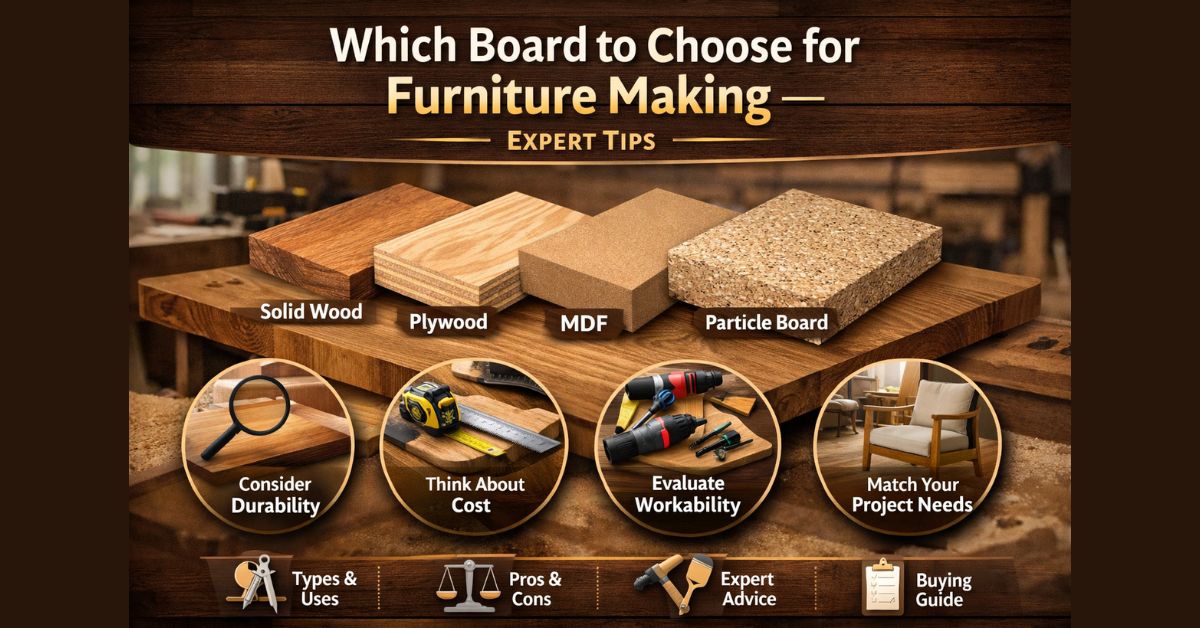
Choosing the correct board for furniture construction determines durability, polish, cost, and long-term performance. As carpentry and interior design professionals, we notice one recurring issue: furniture failures are rarely due to design. They result from ineffective board selection.
Not all boards are made equal. Each has a goal, a strength, and a limitation. When chosen appropriately, the board becomes unseen, quietly carrying out its functions for decades. When chosen incorrectly, it exhibits cracks, bends, and regrets far too soon.
This blog deconstructs every main furniture board option, explains where each one fits best, and assists you in making informed, long-lasting judgments. There is no noise. Just clarity.
Why Board Selection is Important in Furniture Manufacturing
Furniture is meant to withstand weight, wetness, daily use, and time. The board decides if it will.
A well-chosen board provides structural integrity, resistance to warping, smooth finishing, and increased screw-holding capacity. Long-term value for money.
This is why skilled carpenters and architects always source from reputable block board plywood manufacturers in India rather than selecting boards based solely on price.
Understanding the Primary Types of Boards Used in Furniture
Before evaluating choices, it's important to understand what's on the market and what each board is intended to perform.
Block Board—The Backbone of Quality Furniture
Block board is extensively used for furniture that requires strength without excessive weight. Its core is comprised of solid wood strips layered between hardwood veneers.
Block board has several key features, including excellent dimensional stability, strong screw-holding ability, less bending over time, and suitability for extended horizontal spans.
This makes block board an attractive option for premium furniture brands and block board plywood manufacturers in India who value performance over shortcuts.
Best usage includes wardrobes, bookshelves, tables, doors, beds, and cabinets.
A block board is ideal for furniture that needs to remain straight and sturdy over time.
Plywood: Versatile and Reliable
Plywood is created by gluing together many layers of veneer with alternate grain directions. The cross-layer structure provides homogeneous strength and durability.
The benefits of plywood include its high load-bearing capacity, resistance to cracking, and availability in moisture-resistant and waterproof grades. A consistent surface for laminates and veneers.
Many block board plywood producers in India specialize in high-quality plywood, providing solutions for structural and cosmetic purposes.
Best usage includes kitchen cabinets, modular furniture, wall paneling, and flooring bases.
Plywood is a viable option for both household and business furniture.
MDF: Smooth finish, moderate strength
Medium-density fiberboard is composed of compressed wood fibers bound with glue. Its main advantage is surface smoothness.
What MDF does well.
- Ideal for paint finishes
- Simple to cut and shape
- Consistent density
Limitations:
- Low moisture resistance
- Weak screw-holding strength
- Unsuitable for large loads
MDF is best used where looks are more important than strength.
Best usage includes decorative panels, painted furniture, and wall designs.